Thursday, September 02, 2010 / Labels: android
Blogaway
I'm using Blogaway on my Android (phone ) to enter this. It's just a first time test run. See how it works.
Monday, August 09, 2010 / Labels: poetry nomination
Nominated for Asia Writes' Best of the Net 2010 Nominations (Poetry)
This morning I got an email from Asia Writes that my poem was nominated for Asia Writes' Best of the Net 2010 Nominations (Poetry).
Asia Writes asked Lee Upton,author of several books of poetry and literary criticism and currently the Writer-in-Residence at Lafayette College, to pick the best. Nicholas Wong is also in the list.
Thursday, March 04, 2010 / Labels: book review, Dan Rhodes
Little Hands Clapping
 Little Hands Clapping by Dan Rhodes
My rating: 5 of 5 stars
I was waiting to get my hands on this novel for ages, ie, when I first read about it sometime last year. I had a very nice surprise when I collected my copy at Kino. It cost ten pounds but it was a hardback, and with 20% off, a great bargain, as well.
I love reading ebooks, but if this book came out as an ebook and were selling at the same price at this hardback, I'd certain opt for the latter. There is nothing like holding a hardback, when you can open the book flat and not crack the spine, which happens to all paperbacks, including the trade versions.
No matter how great a hardback feels in your hands, it is a waste of your cash if the story sucks. Luckily the story of an old man taking care of a museum of exhibitions of various methods of suicide is absorbing - and hilarious - reading.
The premise makes it sounds as if this is a macabre story. It is and it isn't. It is because Rhodes paints the old man in such creepy a way. He has grey fingers, and he stares ahead at nothing while at work. He has the ability to fall asleep standing or sitting upright. He doesn't seem to eat anything but hard cheese for his meals - and spiders. Every time someone sneeks into the museum to commit suicide, always, a spider creeps into his opened mouth while he's sleeping. He traps it and crunches it and swallows it down.
Another creepy character is the doctor the old man calls after he discovers a dead body. The doctor never reports the incident nor delivers the body to the hospital or the morgue, but bundles it into his car, takes it back to his house and cuts it up. He eats pieces from them as steaks, even feeding his dog Hans certain bits he himself has an aversion to eating.
And these - a penis and a scotum - Hans coughs out one day while the doctor is walking him. A patients the doctor meets on this walk discovers them. She then tells her husband, who then tells the local policeman, who then goes after the doctor.
In the middle of all this is also a love story, of a beautiful girl and a beautiful boy, who are meant for each other. When things go very well for the boy and not so for the girl when they move to the city, the girl despairs and attempts to do herself in in the museum.
Some might call this book a black comedy, because the characters are dark but so funny as well.
View all my reviews >>
Friday, February 12, 2010 / Labels: book review, Sean O'Brien
Afterlife by Sean O'Brien
 Afterlife by Sean O'Brien
My rating: 4 of 5 stars
A bit of a slow start at the beginning. But that's only because O'Brien is building the suspense to the climax. After that the story of a group of university and art students, particularly four, three of whom were aspiring poets, Martin Stone, his girfriend Susie, Alex and his girlfriend Jane.
It is a story of when these four having a stoned time working on their small magazine, in some late 70s, living in some English countryside. It should have been very idyllic, all the drugs and sex. But things started to go wrong when an American Diane, armed with her camera, and a pair of destructive Germans, appeared on the scene. With Diane following them and filming everything, the Germans wreaked havoc during a party, in which they secretly drugged the wine, causing mass hallucination and destruction of properties, of historical papers, books and paintings.
Afterwards things went form bad to worse, for Jane. She had a nervous breakdown, and was killed in a burning building, but somehow circumstances seemed a bit suspicious. Jane had succeeded in getting published before Alex, who became jealous.
Years later they all met again to celebrate the re-burial of Jane, who had gained posthumous fame. Alex had written a falsified account of what happened that time in the 70s with her and their friends. Alex finally had his comeuppance from the most unlikely source, at the end of the book, something you'd have to read without my letting on who.
View all my reviews >>
Thursday, January 28, 2010 / Labels: book review, Cormac McCarthy
The Road by Cormac McCarthy
 The Road by Cormac McCarthy
My rating: 5 of 5 stars
When this book first came out, four years back, there was quite a bit of hoo-ha over it, not in the US or even the UK, but here in Malaysia. This was after it won a few prestigious awards, the James Tait Black Memorial Prize for Fiction in 2006, and then a year later the Pulitzer Prize for Fiction. Malaysians then started to take notice of the book. However the reactions – not the reviews – were varied. One reader loved it, even cried over some bits in it. Some others hated it and cited reasons such as ungrammatical writing.
On the surface, admittedly, there is some kind of grammatical and syntactic quirks about the writing. The overt ones are when Cormac left out the apostrophes from some words, as in “You forget some things, dont you?” (my italics). There are others that are not that obvious, like “Trash in the floor, old newsprint”, “He went down the hallway and stood in the door to the parlor”, “Small cones of damp plaster standing in the floor.” And “They squatted in the road and ate cold rice and cold beans”.
An English language teacher would probably object to the uses of “in” in those sentences. Unless she’s finally grasps the direction Cormac is going.
We can see that the pervading environment in the book’s Earth is a dying one, or rather, an already dead one. Whole cities are burnt down to ashes. The key word here is “ash”. Ash covers everything, and the road the man and the boy are travelling on – or in – is covered with it. What Cormac is saying is that they are walking in the ash, because it is so thick on the road.
All this shows up Cormac as a master of language manipulation. In other instances, some of his sentences smack of Hemingway, the way he can sometimes string several sentences along with just the use of “and”.
Cormac is attempting to say – without saying it but rather showing it – that in the man's and the boy’s dying world, language is devolving down to past its basics, to a place before grammar and syntax. The man tries to stem this by sometimes reading to the boy and getting him to tell him his dreams. The man is pleased and surprised the boy could even read:
“By the roadside stood another sign that warned of death, the letters faded with the years. He almost smiled. Can you read that? he said.
Yes.”
What with all this burning and fire, the ironic thing here is the man tells the boy they are carrying the fire, in them. At the close of the book the boy asks another man, not his father, if he is carrying the fire. He has to be sure before he can leave his dead father and follow this man.
All through the book the main protaganists are just the man and the boy - no names at all. Not even for other characters they meet along the road.
Truth be told, I only read this book after watching the movie. The movie version has kept closely and faithfully to the book, and Viggo Mortensen played the man admirably well. As for the actor playing the boy, he could have at least been a lot thinner or gaunt, like Viggo, all skin and bones. When the man died in the movie I cried a little. When I read that part in the book later, it made me emotional, as well.
Before this, I have to admit that I was foolish to have let the negative reactions of local readers then in 2006 influence me to give the book a miss. Now that I’ve read the book and understood how Cormac uses language so effectively, I’m thrilled, moved and blown away by it.
View all my reviews >>
Watch the movie's trailer:
Thursday, January 21, 2010 / Labels: book review, Colm Tóibín
Brooklyn by Colm Tóibín
 Brooklyn by Colm Tóibín
My rating: 4 of 5 stars
After the very high-brow literary writing of The Master, the style here is very different, more prosaic. The style reflects the way Eilis feels about travelling from her little Irish town, where she practically knows every inhabitant, to Brooklyn, in New York, where she's inundated with humanity of every colour and creed.
She's going to the States to work because at home in Ireland she cannot find work of any kind except working for an uppity shop owner. An Irish priest has travelled from across the waters to help pave the way for her to work in another shop, a much bigger one selling clothes items. He arranges for her to study bookkeeping and to stay at the lodgings of a Mrs Kehoe, who only takes in Irish occupants.
Most of the time she goes to work, comes back for dinner and then bed, or for her bookkeeping classes after work, and gets homesick most of the time. She doesn't have time for anything else, not even for looking up at New York's skyscrapers - the writing here never even alludes to them!
She meets an Italian boy at a dance organised by the church. Their relationship grows despite the uncertainty of her feelings towards him. This uncertainty nearly draws her into another man's arms when she has to go back to Ireland after her sister Rose's funeral. Will she or won't she, is what you'll be wondering. Her Italian boyfriend has persuaded her to secretly marry him before she leaves the States.
The story, the writing style: they are all very straightforward, no linguistic twists, so that this book will cater to even a reader who normally shuns so-called literary novels, especially one, like this book, which was shortlisted for the Booker.
View all my reviews >>
Sunday, January 10, 2010 / Labels: book review, Marina Lewycka
We Are All Made of Glue by Marina Lewycka
 We Are All Made of Glue by Marina Lewycka
My rating: 5 of 5 stars
I think Marina Lewycka has surpassed herself this time with We Are All Made of Glue. I’ve never enjoyed myself so much reading any novel, until this one. What I really mean is I’ve never laughed so much and at the same time flipped pages at the same time.
Georgie Sinclair has just broken up with her hunky husband Rip. He’s tall, heavily-built, with broad shoulders but a too big head, but still gorgeous to Georgie. In fact most of the men she meets throughout this book are of that ilk: the wickedly delectable Mr Diabello, his equally delicious partner in estate agency, Nick, Nathan her editor, and the pair of handsome Palestinian Uselesses, nephews to Mr Ali, a cuddly hamster of a man. All this comes across like some trashy romance novel because Lewycka, or rather, Georgie, has managed to transport some of the elements of Georgie’s novel she’s re-writing after a rejection that mentions the over-use of adjectives.
Georgie puts her wiles on Nathan but the shorter but still hunky Nathan is already in a relationship, with one Raoul. However she manages to put out for Diabello, allowing him to Velcro-strap her in the wrists to her bed and have his way with her while Rip is not living in her house anymore and her son Ben is not back from school yet. As slutty as she seems, Diabello is the only man, after Rip, she lets drop her red knickers for. By the way, Georgie uses her other black knickers on her head to keep the light out of her eyes while she sleeps.
In between all of this sex Georgie is also involved in, in no way sexually at all, with a woman. She first meets ancient Naomi outside her house riffling through her husband’s stuff that she’s thrown out. At the same time she also meets another male of a different kind, an absolutely macho Tom named Wonder Boy, who plays an important role in the outcome of the intrigue involving hospital care workers, social services and rival estate agents, all wrangling to have their claws on Naomi’s huge house Canaan House while she’s incapacitated in hospital and later in an old folk’s home. Georgie is steeped into helping Naomi prevent her house from being grabbed by these people, whom she manages to keep at bay by allowing Ali’s nephews stay in the house while they help repair and renovate it.
Thus Georgie has taken on many roles, as a hot forty-something babe rolling in the bed with Diabello, as a mother after this when Ben comes home from school, as Naomi’s friend and unofficial caretaker and next of kin and matchmaker to Nathan’s father Tati, as Queen of the Cats, with Naomi’s cats following behind her, as screaming, furious harridan when she catches Rip with another woman, as an adventurer plotting to help Naomi escape from the old folks home, as house-carer and occasionally sitter; and finally as a yet-unpublished romance writer taking on freelance work writing articles for a publication all about glue, Adhesives in the Modern World.
Despite Lewycka being an award winner of literary fiction, any reader who knows nothing of this would have a rollicking good read with this book, thinking it’s the best-written chick lit ever come across.
View all my reviews >>
Monday, January 04, 2010 / Labels: book review, Geoff Dyer
Jeff in Venice, Death in Varanasi by Geoff Dyer
 Jeff in Venice, Death in Varanasi by Geoff Dyer
My rating: 2 of 5 stars
After all the hype about this book, what with its winning some awards in Britain, and being touted as a very funny novel, I must say it rather disappoints me – but just a little.
If I compare this funny novel to, say, the one I’m reading right now, Marina Lewycka’s We Are All Made of Glue, I can’t say I was laughing as loudly.
The book is divided into two sections, and they can be so disparate that you can take them as two novellas. The first has the main character Jeff travelling to Venice to do a piece on the Biennale, a huge art exhibition. He hates his job; in the second half of the book he actually tells us he hates writing. That is why in the beginning of the story we see Jeff debating with himself whether to send off an email to his editor telling him in no uncertain terms he is not doing the assignment. But he doesn’t, and flies off to Venice, to get drunk, get drugged and get sexed. Yes, there are pages and pages of description of the latter. Quite graphic, too, so that I can tell you he will never win the bad sex writing award any time soon.
While the first section of the book comes off well as a narrative, the second half rather discards this and goes into travelogue gear. There is practically no plot here. All we read about is Jeff’s opinions about the filth pervading Varanasi. And to give Geoff the writer his due, yes, there are quite funny moments here: when a cow’s shit-encrusted tale slaps into his face and later he suffers the typical gippy stomach of a foreigner; when he and two fellow travelers imbibed some specially-made – if you know what I mean – lassi, and they wander around the place high, Jeff conversing with a goat.
In the Varanasi section, we see Jeff the character clearer, when Geoff the writer describes him as skinny and having greyish hair. Just turn to the back flap of a picture of Geoff and you'll see, at once, that Jeff is somewhat autobiographical.
Even if I think it is not that funny, the book is still readable, especially the first section, and if you are resigned to the travelogue style of writing of the second half.
View all my reviews >>
Friday, January 01, 2010 / Labels: book review, Tobias Hill
The Hidden by Tobias Hill
 The Hidden by Tobias Hill
My rating: 3 of 5 stars
At first I approached Tobias Hill’s The Hidden as a literary piece of fiction, as I was mindful of the fact that he is a poet. So, you can expect him to write like one, meaning some of his sentences are rich in images, just the right formula of ‘Don’t tell, show’.
And show, he does, opening up a historical vista to ancient Sparta. Ben Mercer is an expert on this, and he’s supposed to be working on his thesis. But he never finishes it, and now is having problems with his marriage. He runs away from all this and heads off to Greece. There, he can only get work in a restaurant. When he met someone he knew from his Oxford days, Eberhard, he manages to wrangle a digging job in an archaeological site, and lucky for him, the dig is for ancient Spartan relics.
However Ben never counts on the mess he is going to get into with a small group of fellow diggers. He falls for one of them though, Natsuko. At first the group doesn’t take to him, but that changes after he joins them in a hunt for a jackal. That night he proves his mettle by killing one.
The book is interspersed with Ben’s accounts, possibly his thesis in progress, of ancient Spartan life, all very informative. They pace the book’s story line, so that in the wake of reading one account, you get thrown into the quick of the story.
Slowly Ben learns what has been going on behind the façade of the dig. There is something underhanded going on. Ben finds out what when Eberhard brings him to a place and shows him where he has kept someone, a Greek, a prisoner. Ben gets his first whiff of modern terrorism.
Thereafter, the pace quickens even more, and by the end of the book you see Ben bloodied. He wants to get away from all this with Natsuko. She agrees to follow him but asks Ben to do her a favour first. The ending here is rather full of shocking images, something with which by now you’d know that Hill has been doing very well.
View all my reviews >>
Monday, December 28, 2009 / Labels: book review, Naguib Mahfouz
Adrift on the Nile by Naguib Mahfouz
 Adrift on the Nile by Naguib Mahfouz
My rating: 4 of 5 stars
This book is my first venture or introduction to writings from the middle east, specifically Egypt. So I approached it with some prejudice, inevitably because so far I’ve only read fiction from the West and a couple from the East, most from Japan.
After successfully reading past the first chapter, I was surprised to actually begin to like this book. The absurdist element Naguib Mahfouz introduced very early on in the story sold me entirely, lock, stock and barrel. I was amused by Anis, who works in some government department. Given the task of annotating some procedures, he never realizes at all that his pen had no ink when he was writing, so that he presents pages of blank papers to his superior, who then, rightly, accuses him of being a drug addict.
Which he is, in some way. Every day after work, come evening he takes to a riverboat on the Nile, to smoke hashish with a group of friends. There some old man prepares a water pipe for them. They pass the pipe around and get high, and talk about love and life.
Most of the action in the book centres around the riverboat, and the dialogue actually sounds like a transcription from a play. Which is incidentally what a new guest, a female journalist, Samara, is writing. We know this because Anis looked into Samara’s notebook, and found that she has taken as the players his friends in the riverboat.
With pages upon pages of mere dialogue in this vein, you might be tempted to abandon the book halfway. But, believe me, you won’t, when the talk among Anis’s friends are flirtatious, about women and sex, and philosophical, about the meaning of life then in the 60s of Gamal Abdel Nasser, their country’s leader.
Things stop being idyllic when they decide to drive out in the middle of the night, all of them drunk and high. Returning, their car hits something, they are not sure what. But, the next day they found out from the news, that they killed a man. Guilt follows, especially Anis’ and Samara’s. Anis breaks down from the stress and gets fired from his job. He tries to persuade the others to report their involvement to the police, but they refuse. One of their arguments is that the man’s death is one among many that is a commonality in Egypt.
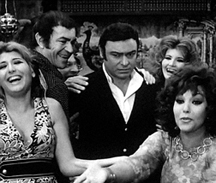
Adrift on the Nile was made into an Egyptian movie in 1971. It is in black and white, which makes me nostalgic for those 60s black and white Eqyptian comical movies Malaysian TV used to show years back. Today you can still sometimes catch such movies on Astro’s Eqyptian channel.
View all my reviews >>
Saturday, December 12, 2009 / Labels: A L Kennedy, book review
What Becomes by A L Kennedy
 What Becomes by A.L. Kennedy
My rating: 5 of 5 stars
After Indelible Acts, Kennedy’s collection from 2002 and her first one, with that long title starting with Night Geometry, this new one, What Becomes, continues her inimical style of writing. She doesn’t subscribe to the type of writing which is taught in most writing schools or classes: simple, to the point, edited to the essentials only, almost to the bare essentials, no superfluous words - in short, very American.
No one could ever teach Kennedy’s style of writing, not even Kennedy herself. It is a style unto its own, very recognisable hers and hers alone. Kennedy, because of this, stands in the same league as another Brit writer, Ali Smith. What is so strange about this is : both of them are from Scotland. However, unlike other Scots writers they do not utilise Scot slang or patois; well, not that much.
In Kennedy’s stories in this collection she gets you into her characters’ heads with inner dialogue, which you’d come to recognise as they stand out in italics. Very unusual this, but perhaps as some kind of distancing from the character, she would sometimes use the second-person pronoun the way another writer would the third-person. I say unusual because this also brings the character’s thoughts and actions a litter closer; a contradiction, I know. She did this so well in her last novel Day.
But, not all the stories here are in this vein. One in which a man and woman talk between themselves prior to and when having some kind of sexual activity is the closest this dialogue-only style veers away from her norm. That piece, called 'Sympathy', can be deemed so intimate, so private, you the reader gets somewhat (yes, it can happen, to me, at least) embarrassed eavesdropping on them.
Then, at the end of the book, Kennedy gets back on track, back to her style, with most poignant story, about a man who has broken up with someone. Before the breakup he had bought them tickets to a magician’s show. Now, apart, he just wants to give away her part of the tickets to anyone who would take it, without paying him. He doesn’t want payment. Finally someone does take his offer, but he sits beside him in the theatre. Kennedy evokes the tension he feels while watching the show and while being aware of his talkative neighbour: quite the best writing for a short story I’ve ever come across.
Actually, quite all the stories achieve this kind of empathy from the reader. From the first story onwards, the title piece, 'What Becomes', you are inside the character’s world, listening to his inner thoughts and emotions, seeing what he sees, which is a cinema screen with no pictures yet, in an empty cine complex. The rest of the stories in the book are just as absorbing to read.
View all my reviews >>
Thursday, December 03, 2009 / Labels: book review, Rachel Cusk
The Bradshaw Variations
 The Bradshaw Variations by Rachel Cusk
My rating: 5 of 5 stars
Apparently some people deem Rachel Rusk too clever in her books. I get that, somewhat, in her past work, like In the Fold. In that one she brandishes here cleverness with long sentences and very, very long conversations. Here, in her new work, she has tempered such lengthiness, somewhat. Sentences are still long, but for the most part they are now shorter and more immediate in their directness and mood.
Basically her novel is about the lives of the Bradshaw clan, particularly Thomas and his wife Antonia, or Tonie as he calls her. Thomas is taking a sabbatical from work, for a year, to take care of their daughter Alexa, while Tonie goes off to head a department in her university, after her promotion. Thomas wants to learn how to play the piano. Meanwhile Tonie, working late, gets propositioned by good-looking visiting lecturers, and finally succumbs to one. As if this is a punishment for straying, she hears bad news about her daughter, when she is taken ill with meningitis and loses part of her hearing. We, the readers, ask, Are they good parents?
This is also the question we ask of Thomas’s other two brothers, Howard and Leo, and their wives, and their parents. To answer for one pair, we see that Mrs Bradshaw doesn’t quite take to Tonie. Claudia, Howard’s wife, thinks taking care of her children has caused her her artistic career.
Don’t start on this book looking for any solid plot, and there is not any, really. All the reader does throughout this not so lengthy novel is step into the Bradshaws’ world of thoughts and observations. However, savour the way Cusk writes – need I say again – so cleverly. A story without plot, this novel, nevertheless, gets your attention with fine details about domestic lives that appear so very normal on the surface, while beneath, deep emotions hover and simmer. Cusk carries these emotions so effortlessly, as per usual, in her so clever way.
View all my reviews >>
Monday, November 30, 2009 / Labels: book review, Ian Pears
Stone's Fall
 Stone's Fall by Iain Pears
My rating: 4 of 5 stars
Stone’s Fall is a historical novel, no doubt. The atmosphere and scenes are steeped in the 19th century – even the language, if I may assert. In essence, though, this novel is a thriller; and one of the best I’ve ever read, even if I ever read one only occasionally.
It has all the usual elements of that genre: intrigue, espionage, sex. These are the main ingredients, but then Spears throws in more stuff: a little bit of the supernatural in the form of séance, and near the end of the book, we realize there has been incest.
The start of the novel shows us the first main character, Matthew Braddock as an old man attending the funeral of a woman he once worked for and fell in love with. The woman is Elizabeth, who had hired him to investigate the death of her husband. She did not believe it was an accident, his falling from a window. Besides, she wanted to find out why he had left a huge sum of money to a child she never even knew existed.
The book is compartmentalized into three sub-books or sections The first has Matthew working for Elizabeth, the second has one Henry Cort working as a spy for the British government; and the last has Elizabeth’s husband, John Stone telling his side of the story, before his death.
So, you can imagine these would make up quite a hefty novel of over 600 pages. Let me tell you, reading it in my Pocket PC took over 3000 flipping of pages! But, despite this, I never tired of it, as the story and the plot thicken with every page.
In the end, Stone’s Fall took me quite a bit of time to finish. At times Pears gives the reader too much dry information about the world of banking and finance, for example. However, when I was approaching the few final chapters of the third book, I couldn’t put the book (or rather the PPC) down. Like any good thriller with spies and intrigues, it has a good dose of explosions in the end. Verdict: this, very cliché, but very unputdownable.
View all my reviews >>
Tuesday, November 17, 2009 / Labels: Adam Foulds, book review
The Quickening Maze by Adam Foulds
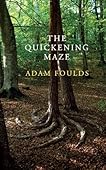 The Quickening Maze by Adam Foulds
My rating: 5 of 5 stars
Adam Foulds’s first book of fiction The Truth About These Strange Times garnered very favorable reviews, and won the Betty Trask Award 2007. This second one, The Quickening Maze is just as successful, even more so when it got shortlisted for the Booker.
It is a historical fiction, just like his other shortlisted Booker candidate Hilary Mantel’s Wolf Hall. But, unlike it, it is shorter, about a quarter of the length. But, like that booker winner again, the writing is exquisite. Just look at these two examples:
Small birds, tit mice … flew off together in a pretty wave of magic.
The thick leaves purred and bounced under sparkling strings of water
They could just fit right into a poem. Which is not unusual, because first and foremost Foulds is a poet, and a prize-winning one, at that. He won the 2009 Costa poetry award for The Broken Word, a narrative about the Mau Mau uprising, in poems.
Again, another comparison with Wolf Hall: his sentences are just as short and pithy. It is as if these two writers have modernized the historical written style while making it relevant to the feel and the mood of those periods. While Wolf Hall’s period is way older, Foulds’s is the 19th century. However, do not presume that this is Fould’s written style. If you read his other book, you’d find the style there quite different, very modern and contemporary.
The story of The Quickening Maze concerns mainly the famous John Clare, a pastoral poet. He is kept in a mental hospital High Beach run by one Matthew Allen. We also meet another famous poet Alfred Tennyson, on whom the doctor’s teenage daughter Hannah has set her sights. Unfortunately, he is short-sighted and vain enough to not wear glasses. He is in - or near - the asylum because of his brother Septimus, the true patient.
As an institution, High Beach can be deemed quite opened or lax - John is able to venture out into the nearby woods. There he happily consorts with the gypsies, who poach the forest’s game. Only when he returns looking the worse for wear after a boxing match that the rules are tightened and he is locked up, for his own safety. Throughout the book we are shown instances of Clare’s worsening mental state: he sometimes thinks he’s Byron, or even Shakespeare, or a boxer Jack Randall.
At times when the story leaves Clare, we see what else is going on in the institution. The doctor Matthew has ideas for a machine that can carve wooden patterns. He solicits capital from Tennyson, who foolishly agrees to contribute. When things sour, the family has to sell of the furniture and other belongings, to pay for debts.
We also see another ugly side of the place. One of the keepers abuses the patients, taking sexual advantage of a female who thinks she is Mary of the Bible. Clare discovers him one day, and threatens to expose him to the doctor, but he is beaten for this. In the end, John is rid of the place when he takes a final outing into the forest with an intent to walk all the way back home, up into north, to his wife, and to Mary, whom he believes is still alive.
This is a very well-written book, with a good pacing of the various stories, of John Clare, Hannah, Tennyson, and the doctor. Definitely re-readable, if only to savour again the poetic feel of the writing.
View all my reviews >>
Friday, October 30, 2009 / Labels: book review, Jane Gardam
The Man in the Wooden Hat by Jane Gardam
 The Man in the Wooden Hat by Jane Gardam
I’ve been a fan of Jane Gardam’s writing ever since I came upon her early books in the British Council Library, like God on the Rocks. I found her stories very moving and her writing very accessible and well-wrought. I still do, especially now, with her latest novel, The Man in the Wooden Hat.
She has reprised her most successful character since Faith Fox, one Edward Feathers. He first appeared as the main character in Old Filth a few years back. The novel was shortlisted for the Booker 2004 but never won. She followed it up with a book of stories, and in it was one starring Edward.
In this book Edward takes a backseat to his wife Betty. We saw her die in the earlier book. Here she lives, as this is like a prequel, like in the movies, like those Star Wars and Star Trek sagas, when the audience gets to go back in time and learn more about their favorite characters. In Hat we certainly now know much more about Betty than just a judge’s wife.
Of some of the things we learn, we might be either ambivalent about or be disappointed with her behavior towards her intended, Edward. We meet her, in the opening of her story, in Hong Kong, when she reads a message from someone. She replies affirmatively, well-nigh ecstatically. We learn she has been asked for her hand in marriage by Edward.
We do not need to know the history of Edward in this book. Some readers would already have been apprised of it from Old Filth. But for those who do not, they would get little reminders of his days growing up in the East, especially Malaya, and in the war with the Japanese. We also meet Edward’s now best friend from those days. Edward saved this little Chinese boy, Albert Gross, and gave him his watch. Later, as adults, they met again, and Gross returned the favour by finding him a legal position. From then onwards, Edward progresses successfully, in life and in his career. Gross has become Edward’s life-long friend – and protector. We see how dwarfish Gross threatens people, even Betty, if they hurt Edward in any way, even emotionally.
As for Betty, she has had a hard life growing up in China. She and her parents were interned by the Japanese, and only she came out of it almost unscathed while her parents died. But she would inherit their money, which is a lot, when she becomes 30. Young and beautiful Betty is penniless and all on her own in Hong Kong, till Edward arrives in Hong Kong.
During a party given by Edward’s employers Betty meets Terry Veneering, and it was lust at first sight. When Edward has to leave Hong Kong to settle some work business, Betty has a tryst with Veneering. This affair leaves a resounding affect on Veneering, who falls for Betty. He even asks her to leave Edward years later when Betty is happily settled down and is an old but still good-looking woman. So, the tension here is, would she leave Edward? Is she happy with him? In the last few chapters you’d get a few surprises.
Gardam’s writing style hasn’t changed much in years. However for this book, she has added a few stylistic twists. At heightened moments her characters would go into a kind of internal direct speech mode. We go into Betty’s thoughts directly. For instance, we see this often when in her last few days on earth, she is distracted, almost dazed from Edward’s point of view. She has just learnt of the death of her ex-lover’s son, Harry.
The Man in the Wooden Hat is still giving Gardam fans reading pleasure, like her earlier books.
View all my reviews >>
Wednesday, October 28, 2009 / Labels: book review, Nicholson Baker
The Anthologist by Nicholson Baker
 The Anthologist by Nicholson Baker
My rating: 5 of 5 stars
In The Anthologist American writer Nicholson Baker writes about my hobby horse, poetry. He waxes throughout his new novel about meter and beats. Not all the time, of course. There has to be a story in there somewhere, or it’ll be merely a teaching text for poetry.
However, the main character, one Paul Chowder (like the milky seafood soup, you know) can be quite pedantic, going on about how ‘poetry is prose in slow motion’ and ‘iambic pentameter is a slow waltz’. All of this very revealing when he goes on to expand on this syllogism.
According to this poet ‘the four-beat line is the soul of English poetry’. He is adamant that the pentameter has actually six beats. The sixth is the 'rest' beat, an invisible beat. That’s quite a revelation, to me. He tries to prove his point by giving us examples. And these are done up quite pictorially, with highlights and such. Sometimes he can go overboard, by turning some bits of poems into music – you get to actually see the music notations illustrated.
Waxing about four-beats, he is, very much, referring to free verse. And, he calls it – the poem – that doesn’t rhyme a plum. Thus the explanation for an illustration of a plum on the cover. He believes that our instinct for rhythm already begins immediately, right after birth. ‘You’re already parsing through, looking for similarities and differences, looking for patterns, looking for beginnings and endings and hints of meaning.’
All this is his way of procrastinating on writing a introduction or foreword for a anthology, of all things, of rhyming poems. His girlfriend, Roz, who lives with him, has enough of this, and moves out in frustration. Sans girlfriend, this may seem kinky but he brings books into his bed. Sometimes we do bring a book to bed, as comfort reading before dozing off; but this is a tinge too much.
Paul teaches his pet subject poetry, but he gives it up, and now he helps his neighbor Nan fix her floor. Later on in the story, when he goes to Switzerland on a conference, he is asked to give a sort of master class on poetry. There, he is overcome by emotions and breaks down in front of his class. Which really clinches the reality that this man cannot teach, ever. Even so, outside of the classroom he is still capable of giving us advice. Like, copy your poem out into a notebook, with a ball-point pen, no less. He promises there’ll be immediate results in your next poem. And this: ‘If you think your writing furthers life or truth in some way, then you keep writing. But if the feeling stops, you have to find something else to do. Or die, I guess.’
Paul believes our instinct for rhythm already starts right after birth. ‘You’re already parsing through, looking for similarities and differences, looking for patterns, looking for beginnings and endings and hints of meaning.’
If any one of us readers write a lot, to practice our craft, as an exercise, he has this to say: Can anyone be said to write too much? He said of Swinburne that ‘Swinburne is like application of too much fertilizer to a very green lawn’.
In between all this poetic proselytizing about four-beat poetry, he goes about his days cleaning up his office, which is a barn. He interacts with his neighbors, especially Nan, who gives him some sort of employment, plays badminton with them and ruminates about the shuttlecock. He cares for his dog, and uses him to bait Roz back, like asking if she’d like to come bath him. He hurts himself, cutting his fingers, and has to call up Roz, to come over and patch him up.
In the end, all I can say is this is a feel-good book. As with all of Baker’s novels, you cannot really pin down any solid plot. Events happen as the character gets on with life, showing us how he does this, with very readable details. Definitely one of Baker's best novels since A Box of Matches, one of my all-time favourite comfort-reads; one that can sustain re-reading, in bed.
View all my reviews >>
Saturday, October 24, 2009 / Labels: book review, Kate Grenville
The Lieutenant by Kate Grenville
 The Lieutenant by Kate Grenville
Kate Grenville’s book The Secret River was shortlisted for the Booker in 2006, but I haven’t yet read it. The Lieutenant is my first encounter with Grenville’s work. That’s because I’m wary of historical fiction. However, after Hilary Mantel’s Wolf Hall I’ve become more accepting of this genre, especially when it sometimes meld over with literature, the hard or real stuff.
When I found this book in the National Library I decided to give a go, even though when flipping through, to quickly review it by sight, I found the font to be childishly large. The size of the print is equivalent to what you find in specially produced large-print books, particularly targeted at older readers who might have trouble reading the normal smaller print.
As of the style of the writing, you cannot subsume it with that of other bestseller-type of historical fiction that most women love to read. Those books usually weigh a ton if in hardback. This one is just over 300 pages. With the large size of the font, you can easily finish reading it in a very short time. Also, the number of pages would be half of 300 odd if the font is done up smaller.
Another factor to the length is the way Grenville never deluges the reader with lengthy details about some historical event or scene, no verbosity at all. She paints with a lightest of strokes, and lays down just a few details about a scene, sufficient for the reader to imagine the whole, even if he has never seen an Australian bush in his life. This way, she gets on with the story.
And the story is about a genius, born in the 18th century, in England. Then little geniuses who could perform arithmetic wonders got sent to the military schools, the best of schools then. How little clever than average Daniel Rooke suffered in such an establishment. Fortunately he got noticed for his uniqueness, especially for his predilection for astronomy. When he got out of this school, he, inevitably, joined the navy, and sailed to Australia. He and his ship mates landed in New South Wales.
There he managed to persuade his superiors to allow him to set up a makeshift observatory. This set him apart, as much as his intelligence did, from his other colleagues. They had to contend with dwindling supplies of food, and having to communicate with the natives there, the aborigines. While they were making attempts at learning some smidgen of the native language, Rooke was ensconced in his little observatory, lost to everything around him except the stars in the sky. Until, that is, when a group of aboriginal women and children came into his environment.
This started a unique relationship, of wonder and respect, between the aborigines and Rooke, especially with a little girl Tagaran. Whenever she visited Rooke would attempt conversations with her using her language. He would note down what Tagaran would teach him. In the process they forged a unique friendship. But this would be tested when Rooke had to join in an exercise to capture six natives, as revenge for their killing one of navy’s one.
Of course, it would be telling too much, especially the ending, if I proceed to reveal the outcome of this. Safe to say, The Lieutenant is a well worth my attempt at getting a first taste of Grenville’s works.
View all my reviews >>
Wednesday, October 21, 2009 / Labels: Bobby, cats
Memories about Bobby


/ Labels: cats
In Memory of Bobby 21-10-2009

My beautiful boy died in his sleep last night.
He was not well for less than two days back. At first I thought it was just a minor stomach ache. Then the second day, he became lethargic. I thought, like my other cats, he would rally and be back into form by a few days.
Yesterday he lay the whole day next to his bowl of water, but he wasn't drinking from it any more. I still didn't think much of it. I went out, to get some books, and came back to find him in the same spot. By evening, outside, at the back of the house, he couldn't bother to even move into the shade when the rain came. I had to carry him inside and place him onto a big pillow.
I watched over him every half an hour, till 2 am. It was then after 5 - too late to bring him to the vet. I thought I'd bring him to the vet in the morning. But when I checked on him this morning at 6:30 am, I saw him in the same position as last night.
I touched him, like I did yesterday, to make sure at least he moved his tail. He wasn't this time. I touched his legs. They were stiff. A film had gone over his half-closed eyes.
He was no more.
The next couple of hours I cried, then went about making breakfast, for myself and the other two cats, a mother and daughter, Mimi and Jane. They are - were, now ? - Booby's granny and auntie.
No way round it, is there, burying him? I wrapped him in my own clean bath towel. I placed a toy - a mouse - under his chin, in the towel. I had been digging a big enough hole in a ground just in front of where I usually park my car.
Several times I couldn't bear to put him into the hole. I lifted a corner of the towel, many times, to see if he was really dead. One last time - sounds so maudlin when it's written down, like this - I took him out of the big towel and held him, very tightly. I kept saying to him, I'm so sorry, I'm so sorry, Boy. Because I should brought him to the vet the very first day he was unwell?
I kissed the top of his head, one last time.
Then I buried him.
My lovely, lovely, beautiful boy.
Sunday, October 18, 2009 / Labels: book review, Doris Lessing
Alfred & Emily by Doris Lessing
 Alfred and Emily by Doris Lessing
My rating: 4 of 5 stars
Is it a novel, that is, fiction? Is it non-fiction, a twin biography of her parents? In fact Alfred & Emily is both. It is kept in the fiction shelves, among other true works of that genre, in the National Library (KL); the librarians presume it to be this.
The first half of the book reads just like fiction. It tells the story of one Alfred and another of Emily. Unlike in real life, when they were Lessing’s parents, these two met at a cricket match, but later married other people instead. At first, if you haven’t known this portion is fiction, you’d have blithely read through the whole thing, thinking it non-fiction done up like fiction. It has a good narrative, three-dimensional characters and a rather viable plot, I must say. The only strange thing about this is that the main characters do not fall in love, like in the movies or in any type of novel. Actually Lessing called this part of her book a novella, because of its length, for one.
The remaining part of the book is the actual story of those two characters. They met and got married, which is how Doris got begotten, a per the way things go in life. Lessing explains to us how she takes bits and moments of her parents lives and put them into the novella, as fiction. However, I find the non-fiction bits, in the latter portion of book, more riveting. There, Lessing gives the reader more details, and she lingers longer to offer them, so that we get a better picture than we would have if he did this as fiction. Her story about her and her parents’ and one brother’s lives in Africa is riveting and fascinating for the pictures it draws. We now know how some kinds of foods made from mealy maize or corn is made and how delicious they were, and that they are no more today, nobody makes them now or knows how to, in Africa or England.
Interesting as Lessing’s book is, it is rather too short for my taste though. I would have preferred a longer work, so that I cannot finish the book in just a few days, so that I can take my time, with pleasure, reading about Lessing’s life with her parents.
View all my reviews >>
Sunday, October 11, 2009 / Labels: book review, Maggie Gee
My Driver by Maggie Gee
 My Driver by Maggie Gee
In this new novel of Maggie we meet Mary Tendo, of old, quite a character, from her last work, My Housekeeper. Mary was, then, the housekeeper of Vanessa, an English writer of middling success. Now, in this story she’s back in her own country, in Uganda. She’s still a housekeeper, but of a different kind, somewhat elevated, in fact. She works for an international hotel, and she has other housekeepers and maids under her.
Throughout the book Mary and Vanessa play hide-and-seek in Uganda. Like a comedy they happen to be in the same place and time but they invariably misses each other. There is a very funny scene in which Vanessa, in Kampala for an international writers conference, actually spots Mary but could hardly recognise her. Mary has stopped by the road side, to buy fruits at a stall. As it happens, she is with none other than Vanessa’s ex-husband, Trevor. Trevor is a plumber in London, and he’s in Uganda to help Mary build or repair some machinery that brings water to a village. Vanessa, too, doesn’t recognise her ex; probably because of the contacts she wearing – vanity in her old age.
In this book, Vanessa hasn’t changed much: still thin, still disgruntled. When we quite liked Mary in the previous book, here, she’s turned into another Vanessa, but much heavier – and curvier – this time. Even Trevor nearly has a fall-out with her, when he couldn’t brook her attitude while driven to the village. We are seeing a whole new Mary, who screams at her child minder; she has a daughter. In the last book we learn her son Jamil was missing, probably kidnapped and forced to be a soldier. Here, we learn that he indeed was, later in the book, quite near the end. In fact the thread running through the narrative is hide-and-seek and happenstance. Happenstance, because things always dovetail neatly in the end, to resolve some issues. How does this happen? Telling you would spoil the ending.
However what I can tell you is Maggie Gee’s writing is superb and nearly flawless. Take the scenes in which Mary is in Bwindi to see gorillas. Also, in the final chapters of the book you’d be able to see how she utilises some poetic elements during some intense moments. Her writing carries through the plot very effectively, so that you’ll laugh at the funny moments, be gripped by the suspense when she is nearly stranded in Bwindi during some heavy downpour, cheer when Trevor, like a movie hero, comes to the rescue, have your heart in your hand reading how they are going to get back to Kampala. An immensely good read. View all my reviews >>
Saturday, September 12, 2009 / Labels: book review, Rose Tremain
The Road Home by Rose Tremain
 The Road Home by Rose Tremain
I’m into the first three pages of the book, and I’ve begun to feel, very heavily, for Lev. An Eastern European, he is going to England, to do any kind of work. His wife has died, and his daughter needs essentials, like clothes and shoes; well, everything, as Lev says, “England is my hope”. He thinks “the English were lucky”, and that it is now his time to be lucky, because he can now freely enter England as a citizen of the EU.
Tremain has made Lev into quite a good-looking, but skinny, character. He doesn’t realize that even with his gray hair and his thin frame he is a looker: Lydia, sitting beside him in the bus, also going to London, to work as an interpreter, thinks so. So does a girl on the street, later in London, when he is drinking outside a pub, and Sophie, one of the chefs in a restaurant in which he works.
He then has an affair with Sophie, but this dies when he realizes he is losing touch with the world, specifically the British world. This happens on the night of the premiere of a play by an important client of the restaurant. It is about incest, of a father towards his daughter. It disgusts and unhinges him, unbalances him, causing him to nearly choke Sophie duing an altercation about the play. He blames the world, other than himself: “This wasn’t his fault. It was the fault of the world”. Not his fault, that he could not control his temper?
He has a bad habit of day-dreaming, which sometimes could cause him trouble, like in the kitchen where he works, at the police station when he is asked to call someone, after his arrest for being a public nuisance. Also, he is irrationally jealous: of his dead wife Marina’s boss, of Sophie. Because of this, he has lost everything, his kitchen job, his girl. He now has to work at a farm, picking asparagus, thanks to Vitas, his former replacement in the kitchen.
Up to now, Lev hasn’t been a character I would be sympathetic with: a dreamer with a bad temper. But, later in the book we see him change, to someone who cares about old people in an old-folks’ home. He becomes their cook, or rather their chef, as he insists on being called because he’s not cooking slop like the kind the former cooks did, who left the home in the lurch. He’s now confident of his culinary skills, after observing professional chefs work. He is now working to save money to open a restaurant back home.
The ending, is, of course, he manages to do this. Tremain has written a well-researched narrative of an EU immigrant or foreign worker working for starvation wages in England. She certainly has done a lot of work on details about cooking. The book reads more like a normal good read than a literary one that gets shortlisted for an award.
View all my reviews >>
Friday, September 04, 2009 / Labels: book review, Hilary Mantel
Wolf Hall by Hilary Mantel
 Wolf Hall by Hilary Mantel
My rating: 5 of 5 stars
At first I’m a little ambivalent about Wolf Hall, notwithstanding all the rave reviews Hilary Mantel is getting for her 600-odd-page historical novel about Thomas Cromwell. The thing is, the way she uses ‘he’ – just that alone – for Cromwell, even when there is another male character present. This can be a bit troublesome, when you take a break and come back from lunch, dinner, supper, etc, from a non-reading activity, to resume reading. You can sometimes get it wrong who the ‘he’ is referring to. After a bit I then get it: if ‘he’ appears in a paragraph alone, it’s Cromwell. Even when Henry (the king, so informal) is in the picture, just be wary – yes, the ‘he’ is also Cromwell.
Also, if you are going to read this novel anticipating long descriptions, just be ready for the spare, lean descriptions to shock your system. Most of the action is predicated upon dialogue. You are to fill in the rest of the scene with just a few strokes of descriptions to help, if at all.
And, there is such an abundance of characters, that, luckily, Mantel has the presence of mind to include a list of them before the start of the book. Sometimes I have to turn to the list, to remind me who that character is in that paragraph.
At the start, we see Cromwell being beaten by his blacksmith father. He runs to his sister for comfort. He grows up, getting experiences on the way, becomes a lawyer, and the right-hand man of one very powerful Cardinal Wolsey. After his – Wolsey’s – fall, he becomes Henry’s right-hand man, helping him annul his marriage to Katherine so that he can marry Anne Boleyn. At the end of the book we see Cromwell cause the fall of another Thomas, Thomas More. In the book we also see the softer side of Cromwell, his grief for the deaths of his wife and daughters during the black plague.
After reading a third through the book, you get accustomed to all these linguistic quirks. Then at the last page, you realize what a good read it all has been, what an amazing feat of stylistics.
View all my reviews >>
Wednesday, September 02, 2009 / Labels: book review, Roddy Doyle
The Deportees by Roddy Doyle
 The Deportees and other stories by Roddy Doyle
-How’s things?
-Grand
Like the immigrants and the sons and daughters of such people in Ireland in the book, they are apprised of this slang, now.
Also, like the illegal immigrant in the story I Understand I might even say ‘fuck that’, as he does when his bus goes past without stopping. He gets the approval of the natives, who approve, telling him, ‘Making the effort’. Oh, and he loves saying, ‘it is grand’. This is one of the phrases he learns from Kevin, a waiter for a bar in which he does cleaning.
This cleaner of offices are one of the scores of black African, poor white Europeans, new arrivals, and even one half-black, Gaswegian-born but raised in Ireland. We read their moving, and often amusing, stories of coping with a strange language and environment, of love, horror, friendships, exploitation. Most of them are light and fun to read because you smile at these people’s adventures. Not all though; one story, a dark one, has a Polish child minder go off the bend after being abused by her employer, whose husband likes to wait for her to come back with their baby in an old pram, from the cold, so that he can enjoy the sight of her damp clothes clinging to her chest.
Doyle does not employ slang like some Scots writers do, with the exception of a few, like ‘howyeh’,’slainte’, ‘shite’. A character from Doyle’s The Commitments makes an appearance in The Deportees. He says ‘shite’ a lot, mostly to singers and bands, and records he doesn’t like.
For all the stories, Doyle keeps the language simple, and sentences are mostly short, the paragraphs, as well. In place of quote marks for speeches, he just utilizes dashes. And this is not always because the characters who are not white Irish cannot make up complex sentences. Notwithstanding the character in I Understand, who is learning the language of his adopted country, everyone else speaks like this, even the half-black Declan who goes to New York to purportedly research black writers’ influence of Irish literature, when he is there to find any connections to his black American grandfather who left his gran with child in Glasgow in the second world war.
All these stories are collected from a monthly Irish multicultural paper, Metro Eireann, started by two Nigerian journalists in 2000. They are now very relevant to a new Ireland, in which Doyle says, “Today, one in every ten people living in Ireland wasn’t born here.”
View all my reviews >>